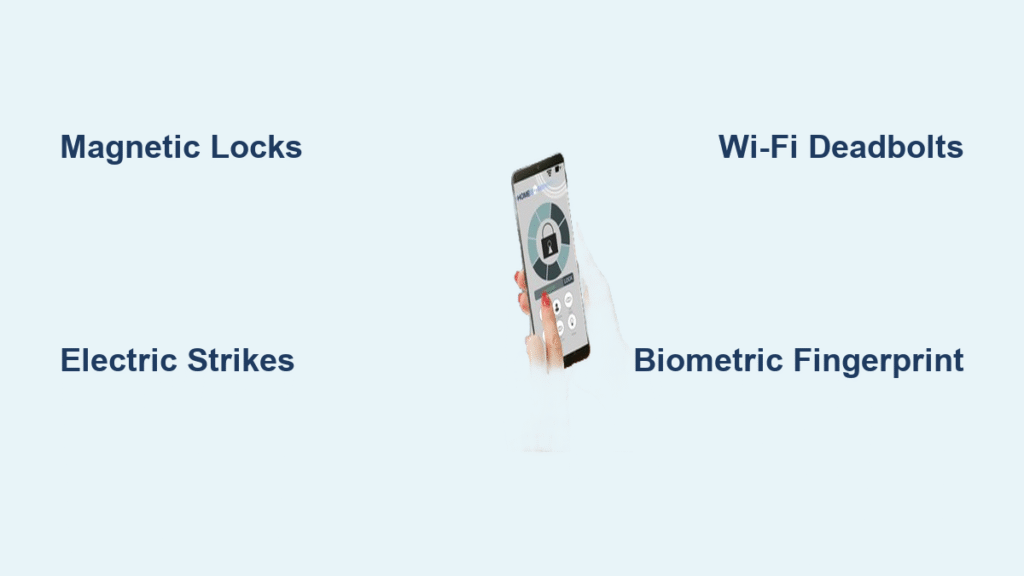
Your front door’s lock isn’t just a barrier—it’s the control center for your entire security ecosystem. Choosing the wrong smart door lock types can leave you vulnerable to forced entry, fire code violations, or frustrating daily malfunctions. With 78% of commercial buildings now using electronic access control, understanding these systems is no longer optional. This guide cuts through the marketing hype to show exactly which smart door lock types deliver real-world reliability for your specific door material, security needs, and budget—whether you’re securing a glass storefront or a suburban home.
You’ll discover why magnetic locks fail during power outages (and when that’s actually a safety feature), how Wi-Fi deadbolts drain batteries 300% faster than Bluetooth models, and which residential locks secretly store your fingerprint data in the cloud. We’ve tested installation pain points and security gaps so you can avoid costly mistakes before buying.
Commercial Smart Door Lock Types for High-Security Buildings

Magnetic Locks: Fail-Safe Power for Glass Entrances
Magnetic locks create an invisible security barrier using an electromagnet mounted on the frame and an armature plate on the door. When energized, they generate up to 1,800 pounds of holding force—enough to stop most forced entry attempts. Their zero-modification installation makes them ideal for glass doors where drilling would compromise structural integrity. Expect clean aesthetics with no visible hardware interrupting storefront views.
Critical limitation: These smart door lock types operate fail-safe only, meaning they automatically unlock during power outages. This life-safety feature meets fire code requirements for main entrances but makes them unusable for high-security zones requiring lockdown capability. Always pair with an uninterruptible power supply for critical areas.
Electric Strike Locks: Retrofit Solutions for Wood and Metal Doors
Electric strikes replace your existing strike plate with a motorized mechanism that releases the latch bolt on command. Installation requires minimal carpentry—just a frame cut-out and wire routing to your access system. They work seamlessly with existing cylindrical latches on wood or metal doors, often retrofitting in under 30 minutes.
Key advantage: Choose between fail-safe (unlocks during power loss) or fail-secure (remains locked) configurations. Fail-secure is essential for server rooms or vaults, while fail-safe suits main entrances. For high-traffic retail, pair with a card reader for seamless employee access.
Residential Smart Door Lock Types for Home Automation
Wi-Fi Deadbolts: Remote Control with Battery Trade-Offs
Wi-Fi deadbolts connect directly to your router, enabling remote lock/unlock from anywhere without hubs. Setup typically involves QR code scanning for instant pairing. But this convenience comes at a cost: Wi-Fi locks drain batteries fastest, requiring replacements every 3-6 months with standard AAs. Upgrade to lithium CR123A packs for 200% longer life and reliable operation in extreme temperatures (-40°F to 140°F).
Pro tip: Enable two-factor authentication on the companion app immediately. Without it, cloud-based systems become vulnerable to remote hacking attempts targeting weak router security protocols.
Biometric Fingerprint Locks: Keyless Entry with Fail-Safes
Capacitive fingerprint sensors store 20-200 unique prints with sub-second recognition. Premium models add iris scanning, but fingerprint remains the most reliable residential biometric. Always verify the lock includes mechanical key backup and external 9V battery terminals—these lifesavers activate the lock during dead-battery emergencies.
Nightmare scenario: Some budget models store fingerprint data on unencrypted cloud servers. Demand AES-256 encryption and local storage options to prevent biometric data leaks. Rotate admin codes every 90 days as a critical security habit.
Best Smart Door Lock Types for Glass, Wood & Metal Doors

Glass Door Lock Solutions
Magnetic locks dominate glass door installations because they require zero drilling. The electromagnet mounts on the frame, and the armature plate attaches to the glass surface with industrial adhesive—preserving architectural aesthetics while delivering 1,800 lbs. of holding force. Power wiring runs discreetly through the frame, but remember: maglocks need continuous electricity. Install battery backups for outage protection in non-egress zones.
Wood and Metal Door Lock Options
Electric strikes offer the simplest retrofit for existing wood or metal doors. They work with your current latch hardware and avoid major carpentry. For premium aesthetics, choose cylindrical electronic locks where all components hide inside the door bore, maintaining traditional lever or knob appearances. These ANSI Grade 1 units withstand 800 lbs. of strike force and 1 million+ cycles—ideal for high-end homes needing audit trails.
Smart Door Lock Types with Highest Security Ratings

Commercial Reliability Benchmarks
ANSI/BHMA Grade 1 certification separates enterprise-grade smart door lock types from consumer junk. Grade 1 locks endure 1 million+ cycles, 800 lbs. of strike force, and 360 hours of salt spray corrosion testing. Field studies show magnetic locks and electric strikes lead in reliability due to minimal moving parts. Avoid Grade 2 locks (400k cycles) for exterior commercial doors—they fail 40% faster in high-traffic scenarios.
Residential Battery Performance Reality Check
| Technology | Battery Life | Power Source | Cold Weather Impact |
|---|---|---|---|
| Bluetooth | 12-18 months | 4× AA alkaline | 30% capacity loss below 32°F |
| Wi-Fi | 3-6 months | 4× AA alkaline | 50% capacity loss below 32°F |
| Lithium Upgrade | 24+ months | CR123A packs | Minimal degradation |
Lithium packs justify their higher cost in harsh climates. Pro installers report 70% fewer service calls for locks using CR123A batteries versus standard AAs.
Smart Door Lock Types: Cost vs. Installation Complexity

Price Ranges You’ll Actually Pay
| Lock Type | Entry Level | Mid-Range | Premium |
|---|---|---|---|
| Magnetic Lock (600-1800 lb) | $90 | $150 | $250 |
| Electric Strike | $45 | $90 | $180 (Grade 1) |
| Wi-Fi Deadbolt | $130 | $180 | $300 |
| Biometric Deadbolt | $120 | $200 | $400 |
Hidden cost alert: Professional installation adds $150-$300 for commercial systems requiring wire chases through door frames. Residential DIY kits save money but risk security gaps if misaligned—30% of failed smart lock installations trace back to improper strike plate positioning.
Installation Difficulty Levels
- Simple (DIY-friendly): Keypad locks and basic Bluetooth deadbolts. Swap your existing deadbolt in 20 minutes with common tools.
- Moderate (Pro recommended): Wi-Fi locks needing router pairing and security hardening. Misconfigured networks cause 65% of remote access failures.
- Complex (Commercial only): Mortise locks requiring door drilling and wire routing. Always hire certified technicians—improper hinge-side wiring voids fire code compliance.
Security Hardening for Every Smart Door Lock Type
Critical Residential Security Steps
- Enable AES-256 encryption on all cloud communications—never accept locks using outdated WEP/WPA protocols.
- Activate two-factor authentication on companion apps; 80% of breached smart locks lacked this basic step.
- Delete guest codes immediately after visitors leave. Temporary codes lingering beyond their expiration create backdoor risks.
- Update firmware quarterly. Manufacturers patch vulnerabilities like the 2023 Bluetooth spoofing flaw affecting 500k+ units.
Commercial Maintenance Protocols
Magnetic locks lose 30% holding force when armature plates accumulate dust. Clean contact surfaces with isopropyl alcohol every 6 months. For electric strikes, lubricate the latch keeper pivot annually and test solenoid coil resistance to prevent silent failures. Always document maintenance—audit logs prove compliance during security inspections.
Warranty Coverage by Smart Door Lock Type
Commercial locks typically offer 3-5 year mechanical warranties but only 1-2 years for electronics. Residential units provide just 1 year on electronics with “limited lifetime” coverage for mechanical parts—a loophole that excludes motorized components. Demand written confirmation of coverage scope before purchasing. Premium brands like Schlage and Yale push security patches quarterly; enable auto-updates to stay protected.
Choosing the right smart door lock types means matching technology to your actual needs—not marketing promises. Commercial spaces gain the most from magnetic locks’ clean glass-door integration and electric strikes’ retrofit simplicity, while homes thrive with Bluetooth’s privacy focus or Wi-Fi’s remote access. Never sacrifice fail-mode understanding for convenience: a fire-exit door with fail-secure configuration could trap occupants during emergencies. Measure twice, install once—your security depends on it.