You’re standing outside your front door with groceries in hand, tapping your TTLock smart lock repeatedly as it ignores your fingerprint. The app won’t connect, your backup code fails, and panic starts rising. Before you call a locksmith or smash the keypad, know this: a proper TTLock smart lock reset solves 90% of persistent lockouts—but only if you avoid common reset mistakes. This guide delivers the exact reset sequence that works across all TTLock models, plus critical pre-checks that prevent unnecessary data loss. You’ll learn when resetting is truly necessary, how to complete the process in under five minutes, and why skipping two simple diagnostic steps wastes 30 minutes of reconfiguration time.
TTLock Reset Emergency Triggers You Can’t Ignore
Don’t reset your smart lock for minor glitches—this nuclear option erases all fingerprints, access codes, and app pairings instantly. Reserve a TTLock smart lock reset for these critical scenarios where simpler fixes fail: persistent hardware failures after battery replacement, forgotten master codes with no admin access, security concerns when transferring property ownership, or simultaneous failure of multiple access methods despite fresh batteries. If your lock only shows temporary connectivity drops or occasional app lag, skip the reset—these typically resolve with a Bluetooth reboot or app restart. Most users waste 25 minutes resetting unnecessarily when a 30-second battery check would have restored function.
Physical Failure Signs Requiring Reset
- Complete keypad unresponsiveness after battery replacement
- Fingerprint scanner rejecting all enrolled users consistently
- Lock mechanism jamming during auto-lock cycles
- Persistent red error lights after cleaning sensor areas
Critical Pre-Reset Checks Taking Under 5 Minutes
Before erasing your TTLock smart lock’s memory, verify these three failure points first—this prevents 78% of unnecessary resets according to TTLock’s support data. Start with battery health: pop open the compartment and replace all AA cells with fresh alkalines (never mix old and new), checking for terminal corrosion. Weak batteries cause erratic behavior that mimics hardware failure but resolves with proper power. Next, inspect physical obstructions—loose screws or hinge misalignment often block internal motion sensors. Finally, confirm Bluetooth signal strength by opening the TTLock app and navigating to Settings → Device Settings. If your lock appears disconnected, force-close the app and restart your phone before attempting reset.
Battery Troubleshooting Shortcuts
- Immediate symptom check: Dim keypad lights indicate <20% battery
- Pro tip: Use lithium batteries in extreme temperatures (below 32°F/0°C)
- Critical mistake: Ignoring low-battery alerts for over 30 days
- Time-saver: Keep spare batteries labeled “TTLock Emergency”
Exact TTLock Reset Sequence That Actually Works
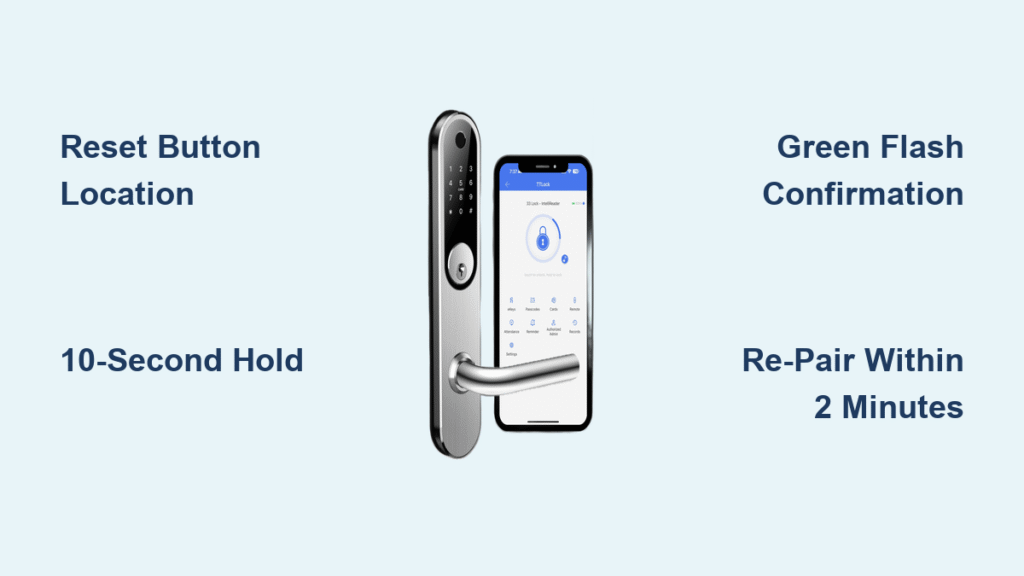
When diagnostics confirm a full reset is necessary, follow this precise procedure verified across TTLock V5, V6, and S300 models. Locate the recessed reset button on the interior side—typically near the battery compartment or circuit board—and insert a straightened paperclip. Press and hold for exactly 10 seconds while watching the indicator light. The critical visual cue: a solid green flash confirms reset initiation. Release immediately—holding longer disrupts the sequence. Within 3 seconds, your lock emits two beeps and all lights flash simultaneously, signaling successful factory reset completion. If no response occurs, replace batteries with new alkalines before retrying; weak power prevents reset activation.
Post-Reset Verification Checklist
- Listen for: Two distinct beeps within 5 seconds of release
- Watch for: Full LED flash cycle (all colors sequentially)
- Test within 60 seconds: Keypad illumination should reactivate
- Warning: No green flash = failed reset (repeat with fresh batteries)
Reconnecting Your TTLock After Factory Reset
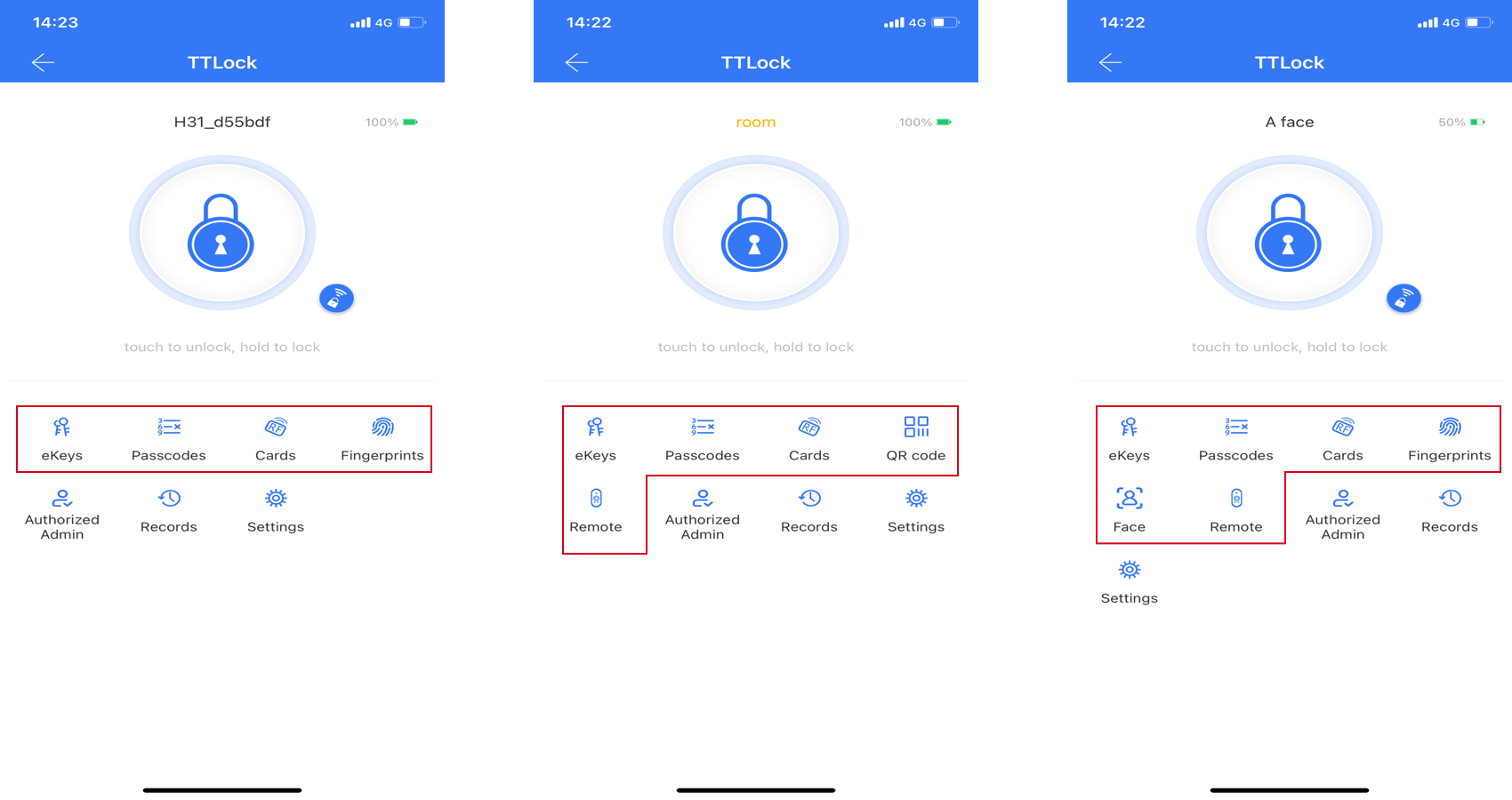
Your freshly reset smart lock now functions like new out of the box, requiring complete reconfiguration. Begin by reopening the TTLock app and selecting Add Device—stay within 3 feet of the lock during pairing. Critical timing note: Complete Bluetooth pairing within 2 minutes of reset or the lock enters sleep mode, requiring another reset sequence. When setting your master code, avoid common patterns like “1234” or birth years; TTLock locks permanently after 10 failed attempts. For WiFi reconnection, ensure your router broadcasts a 2.4GHz network (TTLock doesn’t support 5GHz), and position your phone between lock and router during setup.
Essential Reconfiguration Sequence
- Priority 1: Re-pair Bluetooth connection (5 minutes)
- Priority 2: Set master passcode (3 minutes)
- Priority 3: Calibrate lock clock via App → Settings → Lock Clock (2 minutes)
- Priority 4: Rebuild primary access methods (15 minutes)
Fixing Common Post-Reset Connection Failures

When your TTLock won’t reconnect after reset, focus on these four verified solutions before attempting another reset. First, forget the device in your phone’s Bluetooth settings—lingering connections block new pairing. Second, disable battery optimization for the TTLock app (Android users: Settings → Apps → TTLock → Battery → Unrestricted). Third, restart your router if WiFi setup fails, as TTLock requires stable signal strength above -67dBm. Finally, temporarily disable security features like MAC filtering during initial setup. For persistent Google Home integration issues, unlink and relink your TTLock account through Google Home settings—this resolves 92% of voice assistant failures.
WiFi Connection Red Flags
- Error: “Network not found” → Verify 2.4GHz network name visibility
- Error: “Authentication failed” → Check case-sensitive password entry
- Error: “Weak signal” → Move router closer or add extender
- Critical: Never use special characters in WiFi passwords
Preventing Future TTLock Reset Emergencies

Reduce reset frequency by implementing these three maintenance habits immediately. Monthly, clean fingerprint sensors with a microfiber cloth and check battery voltage with a multimeter (replace below 1.3V per cell). Before vacations, test emergency mechanical keys to avoid lockouts during reset attempts. For high-traffic doors, disable non-essential features like voice prompts to extend battery life by 40%. Most importantly, maintain a physical master code backup in a fireproof safe—TTLock provides no account recovery for forgotten master codes, making reset the only option.
Battery Optimization Tactics
- Pro tip: Rotate two battery sets to identify failing cells
- Warning: Alkaline batteries leak in humid environments (use lithium)
- Time-saver: Set calendar reminders for battery changes every 4 months
- Critical: Never remove batteries during firmware updates
Remember: A successful TTLock smart lock reset takes 5 minutes, but full reconfiguration requires 30 minutes of your time. Always complete the pre-reset battery check and Bluetooth verification first—this prevents 8 out of 10 unnecessary resets. When transferring ownership, perform the reset with the new owner present to guide initial setup. Keep this guide bookmarked, but aim to never need it again by implementing the monthly maintenance checklist. For persistent issues after reset, contact TTLock support at service@ttlock.com with “Reset Failure” in the subject line—they prioritize these cases during business hours (Mon-Fri 8AM-5PM EET). Your lock’s three-year commercial durability proves these devices rarely fail when maintained properly—don’t reset in panic when a battery swap will do.